Why buy house bonsai from us?
- Every house bonsai goes through our greenhouses where we acclimatise it to the home environment.
- From classic ficus to flowering carmonas to exotic serissas.
- You can also choose matching bowls and bonsai pots to go with your tree.
- As the largest bonsai centre in the country , we will also give you our know-how on correct placement with every purchase.
Which bonsai should I choose for my home?
If you are starting out, we recommend focusing on hardy types of indoor bonsai that will forgive you for the occasional grower's hesitation:
- Ficus retusa: An absolute classic, a very hardy and rewarding tree.
- Crassula: Ideal for those who occasionally forget to water.
- Chinese elm (Ulmus parvifolia): An elegant tree that thrives all year round in the right light.
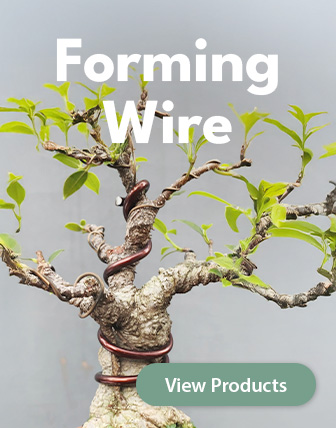
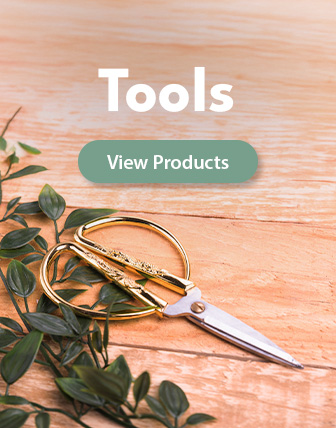
For successful cultivation, don't forget a good quality bonsai substrate and regular feeding with our bonsai fertiliser. If you want to change the shape of the crown, you can do without sharp scissors and aluminium bonsai wire.
Frequently asked questions (FAQ)
How do I care for my indoor bonsai?
The basics are understanding that a room bonsai is a living tree in a confined container space. It requires
regular watering,
plenty of light and a
supply of nutrients through fertilizers. We recommend
turning the plant
regularly so that it receives an even supply of light from all sides and
keeping an eye on the humidity, which is often low in our apartments.
How often should I water my indoor bonsai?
There is no fixed rule (e.g. once every two days) as water consumption varies with the season and the temperature in the apartment. We recommend watering whenever the
surface of the substrate is
dry to the touch but
you can still feel a slight dampness underneath. Keep pouring water until it starts to flow out through the drain holes in the bowl.
How long does a bonsai live?
With proper care, a bonsai can outlive you for a very long time.
Trees that are hundreds of years old are no exception and are passed down from generation to generation. For indoor bonsai, age is limited primarily by
the quality of care and the
stability of the environment. If you give the tree what it needs, it will be with you for decades.
Where to place the bonsai?
Light is life. We recommend placing the bonsai directly on or very close to the windowsill (no more than 1 metre from the window).
Windows facing east,
west or
south are ideal (here, with
care for summer heatstroke). Definitely avoid places
above a switched on radiator or in
dark corners of the room.
How often to prune bonsai?
Indoor bonsai
grow all year round, so
prune them
continuously. We recommend making a maintenance cut (pruning new shoots) whenever they disturb the original silhouette of the tree (usually after 4 to 6 new leaves have grown, cut them back to 1 to 2 leaves). This will encourage the crown to thicken.
How often to repot bonsai?
Young, fast-growing trees usually require
repotting every two years, older specimens
every 3 to 5 years. You can tell the right time by the roots completely filling the tray and pushing up the substrate. We recommend repotting in the spring into fresh, permeable substrate.
What should I do if my bonsai is dying?
The first step is to determine the cause. Most often it is the result of the substrate drying out completely or, on the other hand, the roots rotting due to waterlogging. If the branches are still green under the bark, the tree has a chance. We recommend a 'dip bath' (submerge the entire bowl in a container of water until the bubbles stop coming out) and place the tree in a bright, draught-free location in direct sunlight. Wait to fertilise at this point until the tree starts to grow again.


 All in stock - no illustration photos
 Delivery within 48 hours
 Over 30 years of experience!


 CZ
CZ SK
SK DE
DE PL
PL HU
HU ES
ES AT
AT FR
FR NL
NL IT
IT


