

Pine (Pinus) and spruce (Picea) bonsai represent the pinnacle of what coniferous bonsai have to offer. These evergreen trees will captivate you with their elegant lines, delicate needles, and—in many species—beautiful bark that develops a deep patina with age. You’ll see that an outdoor conifer bonsai will bring a unique atmosphere to your garden. We carefully acclimate all the trees at our center in Libčany and prepare them for successful growth in our climate.
Pines and spruces are classic temperate-zone trees, which means we grow them year-round as outdoor bonsai. Growing pine bonsai, as well as caring for spruce bonsai, has its own specific rules that differ significantly from caring for deciduous trees. Conifers require plenty of light, good air circulation, and a balanced watering regimen. In addition, they grow in close symbiosis with beneficial soil fungi (mycorrhizae), which we must take into account whenever we disturb the root ball.
Conifers thrive best in full sun and an airy location. Ample sunlight is important for the trees to maintain short, compact needles and to prevent the inner branches from losing vigor and dying off. However, spruce is more sensitive to overheating and dry air during the hot summer months, so on the hottest days, it will benefit from light shading and evening misting of the crown.
Proper watering of coniferous bonsai requires a delicate touch. As a general rule, both pines and spruces cannot tolerate prolonged waterlogging. The growing medium should dry out slightly between waterings (the “dry-wet” rule). Spruces are more sensitive to the root ball drying out than pines; however, prolonged waterlogging is just as harmful to them as complete desiccation.
A highly permeable, structured substrate is essential for conifers. Bonsai Master soil, or the Bonsai Master AK-3 mix, has proven effective; it ensures rapid drainage of excess water while providing an ideal environment for the development of beneficial mycorrhizae.
When it comes to fertilizing pine bonsai (low nitrogen), the key to success is proper timing. During spring growth, we apply balanced fertilizers, but with pines, we fertilize carefully so as not to stimulate the growth of needles that are too long. The main feeding season occurs in late summer and fall, when we switch to fertilizers with low nitrogen content and higher proportions of phosphorus and potassium. This helps thicken the foliage, promote the formation of strong buds, and ensure safe overwintering.
Yes, pines (Pinus) and spruces (Picea) are among the most traditional and suitable tree species for the art of bonsai. They are malleable and tolerate wiring as well as advanced deadwood techniques (jin and shari) very well. However, it is important to keep in mind that spruce trees tend to be more fragile and tolerate some radical bending techniques less well than pines.
Place it in a bright, sunny, and well-ventilated spot in your garden, on your patio, or on your balcony. When watering, allow the potting mix to dry out slightly before the next watering, but do not let it dry out completely. Water thoroughly so that water flows out through the drainage holes in the pot. Pines generally tolerate drier conditions, while spruce needs slightly more consistent moisture and protection from hot, dry air.
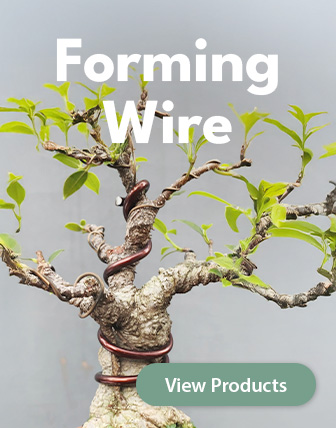
Shaping a pine tree combines wiring and specific bud-training techniques, with the procedures varying significantly by species (black pine, mountain pine, and Scots pine each require a different approach). Wiring is performed using copper or aluminum wire during a period when sap flow is reduced and the branches are more flexible. Growth is controlled by regulating the vigor of the shoots—for two-needle pines, this involves spring pruning of new shoots and cutting back shoots in early summer, followed by autumn thinning of old needles to open up the crown.
Conifers are repotted much less frequently than deciduous trees—older trees once every 5 to 10 years, younger ones roughly every 3 to 5 years. The optimal time is in early spring (usually from late March through April), but this always depends on the specific species, location, and how the winter went. When repotting, clean the root ball very carefully; never trim the roots too drastically, and take care to preserve the natural fungal symbiosis (mycorrhiza) in the substrate.
The main differences lie in growth regulation, sensitivity to drought, and the brittleness of the wood. For pines, we control growth by pinching back spring shoots and reducing buds according to the species. For spruces, spring shoots are usually not shortened entirely, but their soft, sprouting tips are carefully pinched back throughout the spring depending on the vigor of the tree. Spruce also has finer needles, is more sensitive to overheated roots and dry air, and its branches are more prone to cracking during shaping than those of pines.
 All in stock - no illustration photos
 Delivery within 48 hours
 Over 30 years of experience!


 CZ
CZ SK
SK DE
DE PL
PL HU
HU ES
ES AT
AT FR
FR NL
NL IT
IT


